 Skip-the-line available
What to See Inside Palazzo Bo
A room-by-room guide to the Historical tour of Palazzo Bo — the Cortile Antico, Galileo's lectern, the Anatomical Theatre, and the Gio Ponti interiors shown only at weekends.
The Historical tour moves through six centuries in 45 minutes. Here's what each room actually contains, and why it earns its place on the route.
The Cortile Antico
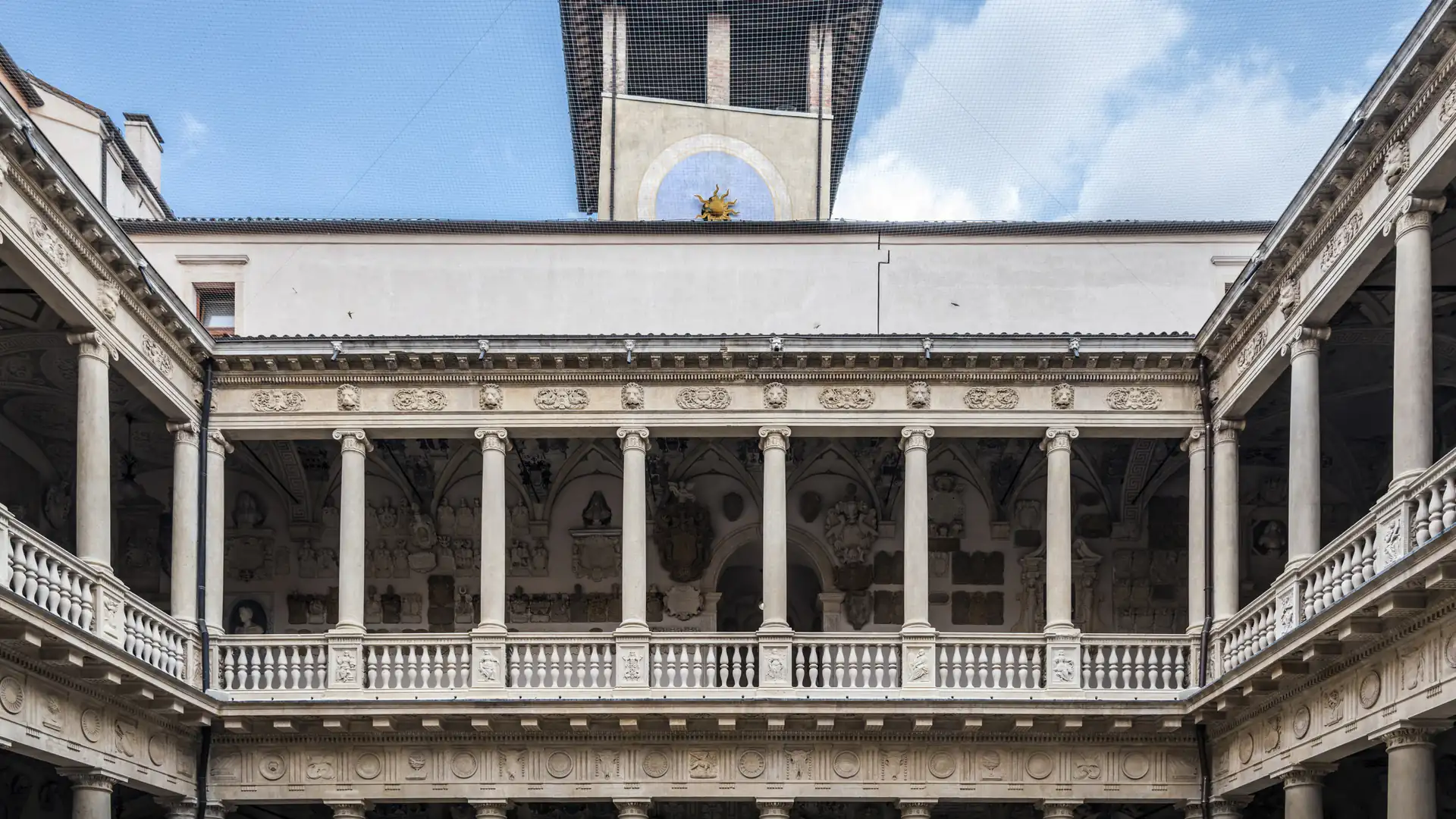
Every visit begins here. The Cortile Antico, the Old Courtyard, is the Renaissance core of the palace, rebuilt by the architect Andrea Moroni in the second half of the sixteenth century around two tiers of columned loggias. What makes it worth slowing down for is what covers almost every surface between the columns: hundreds of carved stone coats of arms, honouring rectors, professors and the historic student "nations" — associations through which students from a given country or region organised themselves — spanning the university's earliest centuries up to the close of the seventeenth. Look up as well as around; the upper loggia carries its own run of crests, and the courtyard's proportions were deliberately designed to feel processional, a stately approach to the ceremonial rooms that follow.
Among the crests, look for the ones marking rectors and professors from beyond Italy — the university's historic “nations” system meant that for centuries, students organised themselves by country or region of origin rather than by subject alone, and German, French, Polish and other foreign communities all left their mark on these walls in stone. It's a physical record of something easy to forget about Renaissance Padua: for a university in a fairly modest Italian city, it drew students and scholars from across the whole of Europe, centuries before the word “international” attached itself to higher education as a selling point.
The Aula Magna
The Aula Magna, the Great Hall, began life as the lecture room of the university's law faculty — the Scuola Grande dei Legisti. It's the room where Galileo Galilei taught mathematics and astronomy from 1592 to 1610, and where enrolment reportedly grew so large that the hall could barely hold his classes. Today its walls and ceiling carry the imprint of a very different era: from the early 1940s, the designer Gio Ponti reworked the hall's backdrop, honour seating and lateral bleachers as part of his wider remaking of the palace's ceremonial rooms, so what you see is a Renaissance lecture hall dressed for twentieth-century academic ceremony. It's still used for degree ceremonies and formal university events today, which is part of why access and layout can vary slightly around the academic calendar.
Sit for a moment, if the tour schedule allows it, and picture the room as Galileo's students would have known it — not the polished ceremonial space of today, but a working lecture hall packed past capacity, with a professor at the front whose ideas about the physical universe were, in his own lifetime, still contested rather than settled fact. The gap between that working classroom and today's carefully restored ceremonial hall is part of what makes the Aula Magna worth pausing in rather than walking straight through: very few rooms anywhere let you stand in the exact space where an idea this consequential was first taught to a room full of sceptical, curious students.
It was also in Padua, while he held this professorship, that Galileo did the work behind his most famous public demonstration: in the spring of 1609 he built an improved telescope, and that August he climbed the Campanile di San Marco in Venice to show it in person to the Doge and the Venetian Senate. Impressed by both the instrument and its obvious military uses — spotting ships far out at sea long before they'd otherwise be visible — the senators doubled his salary and made his university appointment permanent for life. The lecture hall you're standing in and that rooftop demonstration in Venice are, in effect, two scenes from the same Paduan career.
The Sala dei Quaranta and Galileo's lectern
Next door, the Sala dei Quaranta — the Hall of the Forty — serves as the antechamber to the Aula Magna and takes its name from forty portraits lining its walls: scholars, physicians and jurists who taught or studied at Padua between the fourteenth and nineteenth centuries, drawn from more than twenty countries and painted by Gian Giacomo dal Forno. The room's single most photographed object is Galileo's own lectern — tall, plain and built, tradition says, by his own students so that even the back rows of a crowded Aula Magna could see him lecture. It's also the room most closely tied to Elena Lucrezia Cornaro Piscopia, who in 1678 became the first woman anywhere to earn a university degree, an examination so heavily attended it had to move to Padua's cathedral.
The forty scholars painted around the room form a kind of who's-who of Padua's academic reach: physicians, jurists, humanists and anatomists drawn from Albania to Sweden, Scotland to Hungary, each chosen because they studied or taught here at some point between the fourteenth and nineteenth centuries. Read a handful of the names on your way through, if your guide has time to point a few out, and the effect is cumulative — not one famous professor, but four centuries of a university that consistently drew the ambitious and the curious from well outside Italy's own borders, long before travel across the continent was easy or common.
The Anatomical Theatre
The tour's centrepiece, and the room most visitors remember. Commissioned in 1594 by Girolamo Fabrici d'Acquapendente and inaugurated on 16 January 1595, it is the first permanent theatre built anywhere for teaching human dissection — a steep, funnel-shaped structure of concentric wooden tiers, narrower at the small central floor and widening as they rise, so that hundreds of students could stand and still see straight down. Visitors today stand where the professor once stood, on the original dissection floor, and look up into the rings above; climbing the tiers has never been permitted. Beside the theatre sits a small adjoining room the university still calls the anatomical kitchen, where bodies were prepared before being brought to the table below — a detail guides usually point out that's easy to miss without one.
Because the room is small and the tiers steep, the room feels more intimate than photographs suggest — standing at the centre of the original floor, it's a short, direct sightline up through all rings to the small oculus of light at the top, and it doesn't take much imagination to picture several hundred students packed into that space, craning for a view of whatever the professor below was demonstrating. The theatre's continued survival, essentially unaltered since 1595, is itself remarkable: most European anatomical theatres from this era were either demolished, rebuilt beyond recognition, or lost outright, which is part of why medical historians treat a visit here as something closer to standing inside a primary historical document than a museum reconstruction.
The Gio Ponti rooms (weekends only)
On Saturdays, Sundays and public holidays, the Historical tour's four rooms are joined by a genuinely different layer of the building: the interiors the designer Gio Ponti created in the late 1930s and early 1940s under rector Carlo Anti. Ponti designed roughly five hundred individual pieces — chairs, desks, doors, cabinets, even umbrella stands — for the Rectorate, the Sala dei Quaranta, the Aula Magna and the four graduation halls of law, medicine, literature and philosophy, working with the Fontana Arte designer Pietro Chiesa on the lighting. The effect is striking precisely because it sits directly against centuries-older stone: striped terrazzo floors, geometric wooden furniture and bold twentieth-century lines inside rooms whose proportions Galileo would still recognise. It's a route best suited to visitors with an interest in design as much as history, and it's the reason some travellers deliberately choose a weekend departure over a weekday one.
What makes the contrast worth seeking out, rather than simply a curiosity, is how confidently the twentieth-century work sits against the older building rather than apologising for itself. Ponti didn't try to disguise his furniture as period-appropriate — the striped terrazzo, the geometric chair frames and the clean-lined cabinetry are unmistakably of their own moment, the early 1940s, deliberately distinct from the Renaissance stonework around them. Visitors who come expecting a seamless historical palace sometimes find the switch jarring at first; visitors who come knowing what to expect tend to find it one of the more interesting design encounters in the whole building, precisely because the two eras are left to argue with each other rather than blend.
The four graduation halls
Beyond the core historic route, Palazzo Bo still holds four dedicated graduation halls — for law, medicine, literature and philosophy — each refitted by Gio Ponti as part of his early-1940s commission and each still used today for the ceremony every Italian graduate knows well, where a new laureate is formally proclaimed in front of family and faculty. These halls appear on the weekend Gio Ponti route rather than the weekday Historical tour, and because they remain working ceremonial spaces, access can occasionally be affected by an actual graduation taking place. Seeing them is a reminder that Palazzo Bo isn't a preserved-in-amber museum piece: eight centuries after the university's founding, it's still where degrees are awarded, in rooms that carry both Renaissance stonework and a twentieth-century designer's furniture in the same glance.
Each hall carries a slightly different character depending on the faculty it serves — details in the furniture and finishings shift subtly from the law hall to the medicine hall, a reminder that Ponti's commission wasn't a single uniform makeover but a considered response to four different disciplines and their own traditions. If your visit happens to coincide with an actual graduation ceremony taking place in one of the halls, your guide may adjust the route slightly rather than walk a tour group through the middle of it — a small inconvenience that's also, in its way, the clearest possible proof that Palazzo Bo is still a living university building rather than a preserved-in-amber museum piece.
Frequently asked
What's the highlight of the Palazzo Bo tour?
For most visitors, the Anatomical Theatre of 1595 — the first permanent room built anywhere for teaching human dissection. Galileo's lectern in the Sala dei Quaranta and the Cortile Antico's carved coats of arms are close runners-up.
Can I see the Anatomical Theatre up close?
You stand on the original dissection floor at its centre and look up into the concentric wooden tiers. Climbing the tiers themselves has never been permitted, for any visitor.
What is the anatomical kitchen?
A small room beside the Anatomical Theatre where bodies were prepared before being brought to the dissection table below. It's a detail on the guided tour that's easy to miss without a guide pointing it out.
Do I need the weekend tour to see the Gio Ponti interiors?
Yes. The 1930s–40s rooms Gio Ponti designed — the Rectorate, the graduation halls and the reworked Aula Magna — are shown only on the Saturday, Sunday and public-holiday route, not on the weekday Historical tour.
Is the Aula Magna still used today?
Yes. It remains a working ceremonial hall for degree ceremonies and formal university events, which is part of why the exact layout and access can vary slightly around the academic calendar.