 Skip-the-line available
Best Time to Visit Palazzo Bo
How to choose your day, your language slot and your season for the Historical tour of Palazzo Bo and the Anatomical Theatre — and when the weekend route is worth the wait.
Palazzo Bo doesn't have a single "best" day — it has two different guided tours, a weekend self-guided option, three English departures a day, and a city around it that gets busier at different times of year. Here's how to choose.
Weekday Historical tour or weekend Gio Ponti route?
The single biggest decision is which day of the week to come, because Palazzo Bo runs two genuinely different tours. Monday to Friday, the only option is the Historical tour: the Cortile Antico, the Aula Magna, the Sala dei Quaranta and the Anatomical Theatre, in about 45 minutes. On Saturdays, Sundays and public holidays, a second guided route opens up — Palazzo Bo and the Twentieth Century of Gio Ponti — which folds the same historic rooms together with the palace's 1930s–40s interiors: the Rectorate, the graduation halls and the Aula Magna as the designer Gio Ponti refitted them in the early 1940s. If your interest is purely the Renaissance building and the Anatomical Theatre, any weekday works. If you also want to see the twentieth-century layer — which is genuinely different, closer to walking into a period design museum than a medieval palace — you need a Saturday, Sunday or public holiday.
There's a second, quieter reason weekends can suit some travellers better: the self-guided option. Only on Saturdays, Sundays and public holidays can you book a self-guided entrance — a timed entry that lets you walk the rooms at your own pace using on-site audio points, rather than moving as a group with a guide. For most first-time visitors the guided Historical tour is the right call either way — forty-five minutes moves briskly and a guide catches details, like the anatomical kitchen beside the theatre, that are easy to miss alone — but it's worth knowing the self-guided option exists if you'd rather set your own pace on a weekend visit.
It's worth being clear about what a “departure” means in practice, because the language matters here. Palazzo Bo doesn't sell entry the way a museum with open galleries does; every visitor, on every day of the week, joins one specific departure at one specific time, and that departure has a fixed language. Arriving without a booked slot means turning up at the ticket office and hoping a seat remains on whichever departure is next — workable outside peak afternoons, but a gamble if your only window in Padua is a single afternoon squeezed between trains. Booking your date, tour type and language ahead removes that gamble entirely, and it's the difference between a fixed appointment you can plan a day around and an afternoon spent hovering near the ticket office hoping for a spare place.
None of this is really about optimising a single afternoon, either — it's about matching the visit to what you actually want from Padua. The University of Padua has carried the motto “Universa Universis Patavina Libertas,” Paduan freedom for all and everyone, since not long after its 1222 founding, and the two tours embody that history from different angles: the weekday route is the older story of academic freedom and scientific method, the weekend route the newer story of a twentieth-century designer let loose on a Renaissance palace. Neither is the “correct” version of Palazzo Bo; they're simply different slices of an eight-hundred-year institution.
Booking around the English-language departures
Once you've picked weekday or weekend, the next constraint is language. Guided departures run in either Italian or English, and English ones currently run three times a day: on weekdays at 11:30, 13:30 and 16:30, and at weekends and on public holidays at 11:30, 14:30 and 16:30 — every other departure runs in Italian. This is the detail that should really drive your planning: it's less useful to ask "what's the best time of day to visit Palazzo Bo" than to ask "which of the English slots fits the rest of my day." Late morning suits visitors coming in from Venice for the day; the 16:30 departure suits anyone building Padua around lunch and the Scrovegni Chapel first.
Because these English departures are limited and the tour caps group size for the sake of the Anatomical Theatre's floor space, booking your date and slot ahead of arriving in Padua is the single most useful thing you can do to guarantee the visit you actually want, rather than discovering on the day that the English departures left are all full.
It also pays to treat your slot as the anchor for your whole Padua day, rather than an afterthought once everything else is planned. Working backwards from your departure time — deciding what you'll do beforehand, where you'll eat, which other sight you'll fit in first — tends to produce a smoother day than trying to squeeze the tour in wherever a gap happens to appear. If you're also timing the Scrovegni Chapel's own fixed entry window around the same day, picking whichever Palazzo Bo slot leaves the cleaner gap either side of the chapel booking usually makes for the least stressful itinerary.
The best time of day within the tour hours
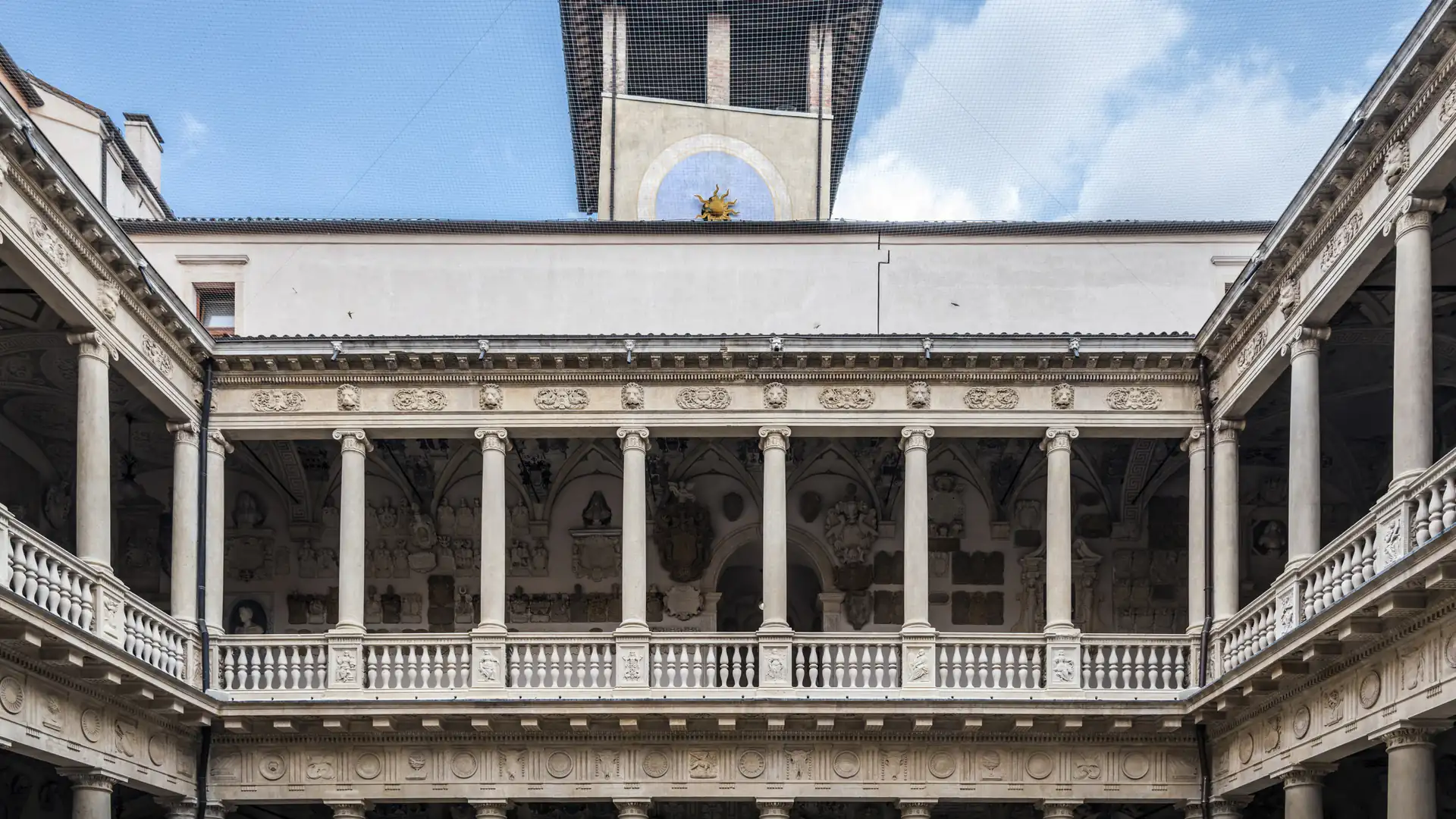
Within whichever slot you book, timing still matters a little at the margins. The ticket office opens at 10:00 on weekdays and 9:00 at weekends, and arriving with time to spare before your departure — rather than rushing in at the last minute — means you're not flustered walking into the Cortile Antico, which rewards a slow look at the coats of arms before the guide moves the group on. The 16:30 departure, being the day's last or near-last, tends to be a slightly smaller and calmer group than the midday slots, which is a small silver lining if you'd rather not share the Anatomical Theatre's floor with a crowd. At weekends, the 11:30 slot generally draws a livelier mix of day-trippers than the afternoon ones, though the difference is modest either way, since group sizes are capped regardless.
Weather is a smaller factor than at an open-air site, since almost the whole tour moves indoors from courtyard to hall to theatre, but the Cortile Antico itself is open to the sky, and a bright morning does more for the coats of arms lining its loggias than a grey one. Padua's climate follows the Veneto pattern generally: warm, sometimes humid summers, crisp autumns, and winters cold enough that an indoor-heavy itinerary like this one is a genuinely sensible choice for a January or February visit, when open-air sights lose some of their appeal. None of this should override the language constraint, though — chasing better light or milder weather is only worth it within whichever days already have an English departure that fits your trip.
Quieter and busier seasons in Padua
Padua's crowds follow two overlapping rhythms: the university's own academic calendar and the tide of day-trippers from Venice, only 26 minutes away by train. Term time — roughly October to May, with a lull around the Christmas and Easter breaks — fills the streets with actual students, which makes the city feel busy but doesn't especially affect tour bookings, since the guided route runs on a fixed schedule regardless. The bigger swing is seasonal tourism: June to September brings the heaviest flow of Venice day-trippers into Padua generally, spreading across the Scrovegni Chapel, the Basilica of St Anthony and Palazzo Bo alike. Spring (April–May) and early autumn (September–October) tend to combine mild weather with a lighter crowd than high summer, and are a comfortable compromise for most travellers building Padua into a wider Veneto itinerary.
It's also worth weighing Padua's seasonal rhythm against Venice's own, since most visitors are moving between the two. Venice's peak crowding — roughly the same June-to-September window — pushes some travellers to shift a whole Veneto trip earlier or later in the year specifically to avoid it, and Padua benefits directly: a shoulder-season visit gets you a genuinely quieter Palazzo Bo alongside a calmer Piazza San Marco on the days either side. If your travel dates are fixed regardless of season, none of this changes which day of the week or which English slot to book — it simply sets expectations for how busy the streets around the palace, rather than the tour itself, are likely to feel.
Padua's own academic year adds one more layer worth knowing about, separate from tourist seasonality: graduation ceremonies happen throughout the year in the very halls the weekend tour passes through, and a booked tour will simply route around one in progress rather than being affected by it. It's a small reminder that, whatever season you visit in, you're moving through rooms that are still doing the job they were built for — not a preserved set piece kept empty for visitors, but a working part of a university that has been continuously operating, with only the odd upheaval, since 1222.
How long to allow beyond the 45-minute tour
The Historical tour itself runs about 45 minutes, but few visitors treat Palazzo Bo as a stand-alone stop. Because it sits in the middle of Padua's historic centre, most people fold it into a half-day or full-day loop that also takes in the Scrovegni Chapel a couple of tram stops away, the Basilica of St Anthony a short walk south, or a coffee in one of the cafés near Piazza delle Erbe. Budget the 45-minute tour itself, plus 10–15 minutes either side for the ticket office and getting to the meeting point, and then decide how much of the rest of Padua you want to see the same day. Visitors coming from Venice as a single day trip typically build their whole day around their Palazzo Bo departure time, seeing one or two other sights before or after, rather than trying to fit everything Padua offers into a single afternoon.
If Palazzo Bo is your only booked commitment of the day, it's worth resisting the urge to schedule everything else around it too tightly. Padua's charm lies largely in unplanned wandering — the porticoed streets between Piazza delle Erbe and Piazza dei Signori, the university district's cafes filled with actual students rather than tourists — and a Palazzo Bo booking works best as the one fixed point in an otherwise loose day, rather than the first of several tightly timed reservations. Visitors who also book the Scrovegni Chapel are the exception: with two timed entries in one day, allow a genuine buffer between them rather than assuming you can walk straight from one departure into the next.
If you're travelling with a specific interest in the history of science or medicine, it's worth allowing a little extra time before or after your slot simply to sit in one of the cafes near the university district and take in the fact of the place — a city that produced Galileo's astronomy, Fabrici's anatomy and Harvey's discoveries within a few hundred metres of one another, over the span of about a century. Palazzo Bo rewards that kind of unhurried reflection more than a rushed tick-box visit ever could.
Frequently asked
What's the best day to visit Palazzo Bo?
It depends what you want to see. Any weekday works for the Historical tour — the Renaissance rooms and the Anatomical Theatre. Choose a Saturday, Sunday or public holiday if you also want the Twentieth Century of Gio Ponti route and the option of a self-guided visit.
What time is the English tour?
English guided departures currently run three times a day: on weekdays at 11:30, 13:30 and 16:30, and at weekends and on public holidays at 11:30, 14:30 and 16:30. All other departures run in Italian, so book your date around one of these times — or, at weekends, choose the self-guided entrance instead.
Is Palazzo Bo less crowded at a particular time of day?
The 16:30 departure, the day's last or near-last, tends to be a slightly smaller group than the midday slots. At weekends, the afternoon departures are usually a touch calmer than 11:30, though group sizes are capped on every departure regardless.
What season is best for visiting Padua and Palazzo Bo?
Spring and early autumn combine comfortable weather with lighter crowds than high summer, when Venice day-trippers peak. Term time, roughly October to May, fills the streets with students but has little effect on the guided tour schedule itself.