 Skip-the-line available
The History of the Palazzo Bo Anatomical Theatre
How a fifty-year professor of surgery built the first permanent room in the world for teaching dissection — and how it shaped three centuries of medicine.
No room at Palazzo Bo draws more visitors than the Anatomical Theatre. Here's the fuller story of why it was built, how it worked, and who stood in its tiers.
Anatomy at Padua before the permanent theatre
Padua's reputation for anatomy predates the theatre by decades. In the 1530s and 1540s the Flemish anatomist Andreas Vesalius taught here, producing work that would overturn centuries of inherited assumptions about the human body — but he did it in temporary wooden theatres, built for a course of lectures and dismantled again afterwards, the standard practice at every European medical school of the time. That impermanence had real costs: constructing and demolishing a theatre for each course was expensive and slow, and a temporary structure limited how many students could safely attend a dissection. By the later sixteenth century, Padua's medical faculty was attracting students from across Europe specifically for its anatomical teaching, and the case for something built to last had become obvious to anyone actually running the courses.
Vesalius's own Padua lectures are part of why the university's medical faculty had such prestige to protect by the 1590s: his 1543 book on the structure of the human body had already overturned centuries of anatomical teaching that leaned on ancient authority rather than direct observation, and much of that observational method had been demonstrated, publicly, in Padua's own temporary theatres. By the time Fabrici proposed something permanent, he wasn't introducing a new idea to the university so much as formalising a tradition of hands-on, publicly demonstrated anatomy that Padua had already spent half a century building its reputation on.
Fabrici d'Acquapendente's theatre
The person who finally acted on that case was Girolamo Fabrici d'Acquapendente — known in Latin as Hieronymus Fabricius — who held Padua's chair of surgery and anatomy for fifty years and had trained a generation of Europe's physicians by the time he proposed a permanent theatre in 1594. The university funded the project directly, and construction moved quickly: the theatre was built as a steep, elliptical funnel of concentric wooden tiers rising around a small central floor, each ring wider than the one below it, so that a packed audience could stand tier above tier and still see clearly down to the dissection table. It was inaugurated on 16 January 1595 — barely a year after Fabrici proposed it — and it survives today essentially as it was built, the oldest room of its kind anywhere in the world.
The design itself is credited in some sources to the polymath Paolo Sarpi, working with the painter and architect Dario Varotari, though it was unmistakably Fabrici's project and Fabrici's vision that drove it into being — he held the anatomy chair for fifty years and had every reason to want a legacy that would outlast a single course of lectures. The elliptical, inverted-cone shape wasn't arbitrary: it let a very large number of people stand in a genuinely small footprint while keeping every sightline trained on the same small table below, solving the basic problem that had made earlier temporary theatres so limited in size. It remains, structurally, an unusually elegant answer to a specific and slightly grim design brief.
Fabrici's own scientific legacy is bound up with the theatre in another way, too. In 1603 he published De Venarum Ostiolis — “On the Valves of the Veins” — the first clear description of the small valve-like flaps he'd discovered inside the veins nearly thirty years earlier, illustrated with detailed life-size copperplate engravings. He never worked out what the valves were actually for, guessing they simply slowed the blood to stop it pooling in the hands and feet. It would take his own student, standing in this theatre a few years later, to see what Fabrici had missed.
How a dissection actually worked
A public dissection at Padua was a formal, crowded event, not a private procedure. The professor worked at floor level among the students rather than above them, using the small central table as his stage while hundreds watched from the tiers rising around him. Bodies were prepared beforehand in a small adjoining room the university still calls the anatomical kitchen, then brought down to the table for the lecture itself. By custom, the bodies used came from among those condemned to death, and specifically from outside both Padua and Venice, so that neither city had to see one of its own citizens on the table — a rule that reveals how carefully the era balanced anatomy's scientific value against its social discomfort. Because bodies decomposed quickly and Padua's winters offered the only reliably cool weather, dissections were traditionally held in the winter term, which is part of why the theatre's original entrance and layout were designed around a fairly compressed teaching season rather than year-round use.
Dissections were formal academic events with their own etiquette, not the clinical procedures we might picture today — attendance could include visiting scholars and notable guests as well as enrolled students, and the professor's running commentary from the floor was as much the point as the anatomy itself, a live demonstration of argument and evidence rather than a silent procedure. The physical intimacy of the room was part of the design: unlike a modern lecture hall, nobody in the Anatomical Theatre was more than a few tiers from the table, which meant even the back rows could follow fine anatomical detail in a way a larger, flatter room would never have allowed.
The winter timing wasn't only about slowing decomposition, either — it also matched the university's own teaching calendar, since the main anatomy course ran through the colder months when the medical faculty's other lectures were already in session, and visiting foreign students were already in the city for the year. A dissection course could stretch across several sessions rather than a single afternoon, with Fabrici returning to the same body over consecutive days to work systematically through different organ systems, which is part of why a genuinely permanent, comfortable theatre mattered so much more than a temporary one ever could.
The students who stood in its tiers
The theatre's real legacy is the roll call of people who once stood in its galleries. Among Fabrici's own students was a young Englishman, William Harvey, who arrived at Padua in December 1599 and graduated a Doctor of Medicine in 1602. Fabrici had already discovered small valve-like structures inside the veins, without ever working out their true purpose; Harvey carried that half-finished observation back to England, and it became a building block of his own landmark account of how blood circulates continuously around the body, a foundational moment in modern physiology. More than a century later, Giovanni Battista Morgagni taught anatomy at Padua and is remembered today as the father of modern pathological anatomy, for his work connecting disease to specific changes inside the body — proof that the theatre kept producing consequential medicine long after its first famous graduate had gone home.
Fabrici's influence reached well beyond his own direct students, too, since Padua's medical degree carried enough prestige across Europe that physicians who trained here returned home and taught their own students using methods learned in this room. That ripple effect is part of why historians of medicine treat the Anatomical Theatre as more than a single university's curiosity — it functioned, for the better part of three centuries, as one of the places European medicine's working methods were actually formed, tested and passed on, rather than simply a well-preserved historical curiosity that happens to have survived intact.
That student was William Harvey, who used Fabrici's valve illustrations as evidence for something far bigger: not that blood pooled and needed slowing, but that it moved in one continuous direction only, out through the arteries and back through the veins, circulating around the body in a closed loop. Harvey didn't publish that theory until 1628, more than two decades after leaving Padua, in a short book known by its shortened Latin title, De Motu Cordis — but the seed of it, by his own account, was planted watching Fabrici's dissections from these tiers. Padua's anatomical teaching kept producing landmark figures long afterwards, too: Giovanni Battista Morgagni held the university's chair of anatomy for more than fifty years, and his 1761 masterwork correlating disease with physical changes found in around 640 dissections is still credited with founding pathological anatomy as a discipline in its own right.
From working theatre to preserved room
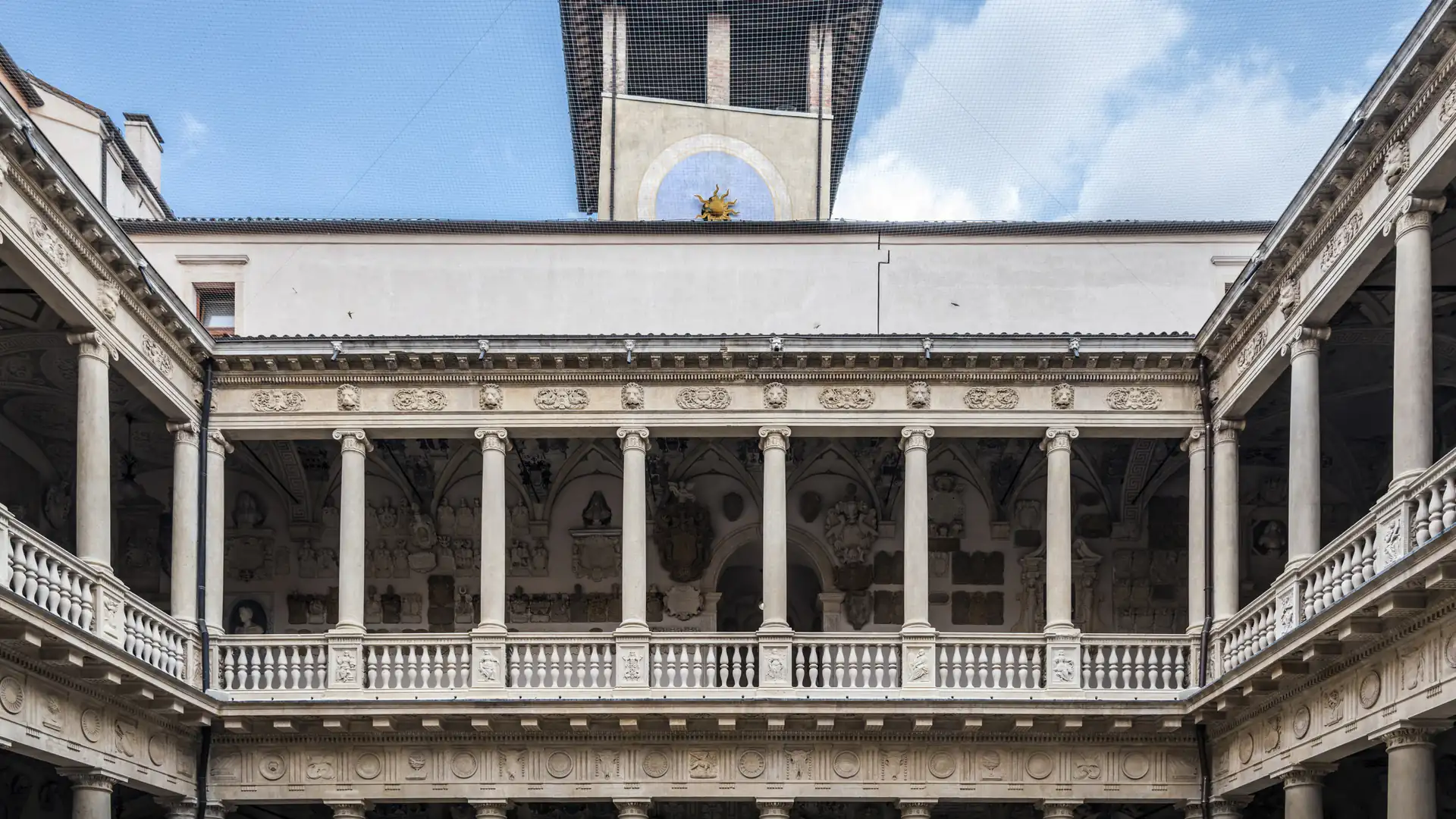
The theatre stayed in continuous use for close to three hundred years, a working teaching space rather than a monument, until 1872, when Padua's medical school had grown too large for Palazzo Bo altogether and relocated to purpose-built premises elsewhere in the city. Rather than being altered or absorbed into some other use, the theatre was preserved as it stood — a decision that's the reason visitors today can still see a genuinely original sixteenth-century anatomical theatre rather than a later reconstruction. It now sits within a palace whose ceremonial rooms were substantially reworked by the designer Gio Ponti in the early 1940s, so a visit to the theatre today means stepping past twentieth-century interiors to reach a room that has changed astonishingly little since Fabrici's own students first climbed its tiers in January 1595.
Visiting today means experiencing a genuine paradox: a room built for a very specific, very grim sixteenth-century purpose, now preserved precisely because that purpose ended. Had the medical school never outgrown Palazzo Bo, the theatre might well have been renovated, expanded or replaced entirely to keep pace with modern medical teaching, the way most of Europe's early anatomical theatres eventually were. Its abandonment in 1872, in a strange way, is exactly what saved it — and it's worth holding that thought while you stand on the original floor, looking up at tiers that have needed no reconstruction because nobody, for over 150 years, has had any practical reason to touch them.
Frequently asked
Who built the Anatomical Theatre of Padua?
Girolamo Fabrici d'Acquapendente, who held Padua's chair of surgery and anatomy for fifty years, proposed it in 1594. The university funded construction directly, and it was inaugurated on 16 January 1595.
Was it really the first permanent anatomical theatre in the world?
Yes. Earlier anatomists, including Andreas Vesalius decades before, taught dissection in temporary wooden theatres built and dismantled for each course. Fabrici's theatre was the first meant to stand permanently, and it survives essentially as built.
How were bodies obtained for dissection?
By custom, from among those condemned to death, and specifically from outside both Padua and Venice, so that neither city saw one of its own citizens on the table. Dissections were traditionally held in winter, when the bodies would decompose more slowly.
What is William Harvey's connection to the theatre?
Harvey studied at Padua from 1599 and graduated in 1602, taught by Fabrici, the theatre's founder. Fabrici's own discovery of valves inside the veins fed directly into Harvey's later work describing the circulation of blood.
When did the Anatomical Theatre stop being used?
It remained in continuous use for close to three hundred years, until 1872, when Padua's growing medical school relocated to purpose-built premises elsewhere in the city. The theatre itself was preserved rather than altered or reused.