 Skip-the-line available
Palazzo Bo or the Scrovegni Chapel?
Padua's two unmissable, timed-entry sights compared — what each one actually gives you, how they differ, and why most visitors should book both.
Padua's two must-books couldn't be more different in scale, yet both run on timed, capacity-limited entry. Here's how to decide between them — or better, how to plan both.
Two very different kinds of visit
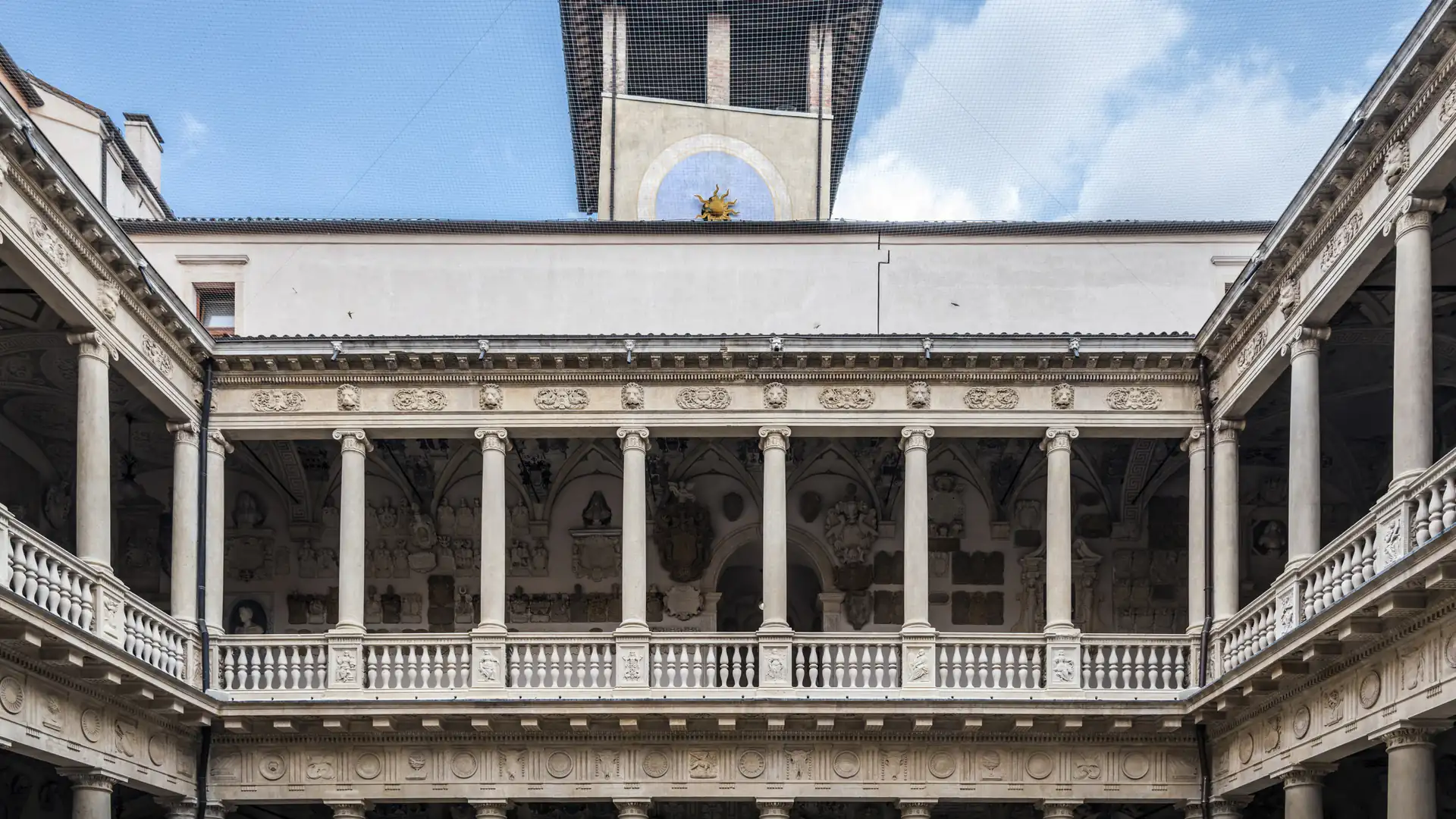
Palazzo Bo and the Scrovegni Chapel are Padua's two most-booked sights, and travellers with limited time often assume they have to choose. They don't have much in common beyond that popularity. The Scrovegni Chapel is a single small room, entered for a tightly controlled window of around fifteen minutes, built around one continuous achievement: Giotto's fresco cycle of 1302–05, thirty-eight scenes covering roughly a thousand square metres of wall and ceiling. Palazzo Bo is the opposite kind of visit — a 45-minute walking tour through an entire working university building, moving across nearly four centuries of history in a single circuit, from a Renaissance courtyard to a twentieth-century interior by way of the world's first permanent anatomical theatre. One is a concentrated encounter with a single masterpiece; the other is a longer journey through many.
That difference in scale also shapes how each site handles the crowds it draws. The Scrovegni Chapel's tiny size and fragile frescoes mean its capacity limits are strict almost to the point of rationing — a fixed number of visitors, a fixed number of minutes, no flexibility once your slot begins. Palazzo Bo's constraints are looser in one sense, since a 45-minute walking tour can comfortably hold more people moving through a sequence of larger rooms, but tighter in another: because English departures are so limited, the practical bottleneck isn't room capacity but language availability, which is a different kind of planning problem entirely.
It's worth remembering, too, that both sights sit inside the same broader story of a city that has spent eight centuries attracting outsiders — students to the university, and, in Giotto's case, one of the most consequential painters of the whole Italian tradition, commissioned by a wealthy Paduan banker rather than the city's own artists. Padua's pull has never really been about producing its own famous names so much as drawing extraordinary people from elsewhere and giving them room to work.
What the Scrovegni Chapel actually gives you
The Scrovegni Chapel's power is concentration. Commissioned by the wealthy Paduan Enrico degli Scrovegni and painted by Giotto over roughly two and a half years, its walls carry a single unbroken narrative of the lives of the Virgin Mary and Christ, rendered with a realism and emotional directness that had no real precedent in Western painting — which is why art historians treat it as a genuine turning point. Because the frescoes are fragile, visits are tightly timed and capped, typically preceded by a short wait in a climate-controlled anteroom before the doors to the chapel itself open for a fixed window. It rewards visitors who come ready to look hard and fast rather than linger, and who understand before they arrive that this is a fifteen-minute encounter with one room, not a browse through a larger museum.
It's worth knowing, too, that the anteroom wait before entering isn't wasted time — it exists because the chapel's climate-controlled environment needs visitors to acclimatise before entering, protecting frescoes that are genuinely irreplaceable. Treat it as part of the visit rather than a queue to get through: the anteroom typically includes some context on Giotto and the chapel's patron, Enrico degli Scrovegni, which primes you for what you're about to see far better than walking in cold. Visitors who expect only the fifteen minutes inside sometimes undervalue this preparation; visitors who go in already knowing a little about the fresco cycle's structure tend to get more out of the time once the doors open.
The chapel's UNESCO status adds one more layer worth knowing: since 2021 it's been inscribed, alongside seven other painted buildings across the city, as part of “Padua's fourteenth-century fresco cycles,” recognising the wider concentration of trecento fresco painting the city holds beyond Giotto alone. Visitors with time for only one of those eight sites overwhelmingly choose the Scrovegni Chapel, and for good reason — but it's worth knowing, if your trip allows for more, that Giotto's masterpiece is the headline act of a genuinely deeper collection.
What Palazzo Bo actually gives you
Palazzo Bo trades concentration for range. In a single 45-minute guided circuit you move through the Cortile Antico's carved coats of arms, the Aula Magna where Galileo lectured for eighteen years, the Sala dei Quaranta and his surviving lectern, and the Anatomical Theatre of 1595 — the first permanent room built anywhere for teaching human dissection, and still essentially as Fabrici d'Acquapendente left it. Where the chapel is about looking at one continuous artwork, Palazzo Bo is about standing inside a working institution's own history: a functioning university building, still home to the Rectorate and law school today, where you can trace eight centuries of academic life across half a dozen different rooms and, at weekends, a whole extra layer of twentieth-century design by Gio Ponti on top.
There's also a difference in what each visit asks of you physically and mentally. The chapel rewards quiet, concentrated looking — you're essentially reading a continuous visual narrative across the walls and ceiling in a fixed, short window. Palazzo Bo rewards curiosity and movement: following a guide from room to room, absorbing a spoken narrative alongside the architecture, and covering real physical distance within the building. Travellers who find themselves tiring of gallery-style, stand-and-look visits by the end of a long Italy trip often find Palazzo Bo's more active, guided format a welcome change of pace precisely because it doesn't ask you to stand still for very long in any one place.
Palazzo Bo's range also means it appeals differently depending on what you already know coming in. Visitors with some background in the history of science or medicine tend to find the Anatomical Theatre the emotional high point of their whole Italy trip, not just their day in Padua; visitors with no particular interest in that history still generally come away struck by the Cortile Antico and the sheer improbability of Galileo's lectern surviving, physically, in the room next to where he once stood.
If you only have time for one
If your Padua time really is down to a single booking, the honest answer depends on what draws you. Travellers whose interest is art history, and who'd rate the Sistine Chapel or the Last Supper among their reasons for visiting Italy at all, should prioritise the Scrovegni Chapel — Giotto's frescoes are that significant, and there's no substitute for it elsewhere. Travellers drawn more to the history of science, to Galileo, or simply to walking through a genuinely old, still-functioning institution, will get more out of Palazzo Bo, since nothing about the chapel touches that story at all. Families and anyone travelling with children under about ten often do better at Palazzo Bo too, since a 45-minute walking tour with a guide holds attention more easily than a strictly timed, largely static fifteen minutes in a single small room.
There's a practical tie-breaker worth knowing too: because the Scrovegni Chapel operates on a stricter, more heavily booked capacity system, its slots for popular dates can fill up further in advance than Palazzo Bo's do. If you're planning close to your travel dates and find the chapel already fully booked for the day you want, that alone may settle the choice for you — Palazzo Bo's guided departures, while still limited by language, tend to have more give in the schedule than the chapel's tightly rationed entry.
One more consideration, if science and medicine specifically drew you to Italy: nowhere else in the country — arguably nowhere else in the world — puts you inside the actual room where Fabrici discovered a mechanism that fed directly into Harvey's account of blood circulation, one of the true foundational moments of modern medicine. The Scrovegni Chapel has no equivalent claim in the history of science, however towering its place in the history of art.
Booking both in a single day
Most visitors, in practice, don't have to choose — the two sights sit close enough together that booking both in one day is entirely realistic, and it's what we'd recommend if your schedule allows it. The Scrovegni Chapel is near the Eremitani tram stop, two stops from Padova railway station; Palazzo Bo sits a few minutes from Ponti Romani, one stop further along the same SIR1 line, so moving between them is a short tram ride or an easy walk through the historic centre. Because both run on timed, capacity-limited entry, the only real planning task is booking each for a time that leaves a comfortable gap between them — the chapel's fixed fifteen-minute window either side of Palazzo Bo's 45-minute tour, with enough slack for the walk or tram ride and a coffee in between.
If you do book both, there's no strict rule about which should come first — some visitors prefer starting with the chapel's concentrated fifteen minutes while they're fresh, saving the longer, more relaxed Palazzo Bo tour for afterwards; others prefer the reverse, treating Palazzo Bo as a warm-up before the chapel's more demanding, focused visit. What matters more than the order is the buffer: don't schedule the two back-to-back with only the bare minimum walking time between them, since a delayed train, a slow queue at either ticket office, or simply misjudging the walk can turn a tight but workable plan into a missed booking at either end.
Whichever order you choose, both bookings share one planning principle worth repeating: confirm your date and slot before you leave home, or at the very latest before you board the train from Venice. Both sights run on strictly timed entry with no flexible walk-in fallback, and turning up to either without a confirmed slot risks losing the one from your day entirely, in a city where you otherwise have very little else that needs booking in advance at all.
Frequently asked
Should I book Palazzo Bo or the Scrovegni Chapel first?
Neither has to come first — book both around a time gap that suits your day. Many visitors do the chapel's fixed fifteen-minute window either before or after Palazzo Bo's 45-minute tour, with a short tram ride or walk between them.
Can I visit both in one day from Venice?
Yes, comfortably. Both sights sit within a few minutes of the same SIR1 tram line in central Padua, and a single day trip from Venice leaves enough time for both plus lunch, provided you book each in advance.
Which is better for children?
Palazzo Bo generally holds children's attention more easily — it's a 45-minute walking tour with a guide, versus the chapel's static, strictly timed fifteen minutes in one room. Children with a specific interest in art may still prefer the chapel.
How far apart are Palazzo Bo and the Scrovegni Chapel?
About one stop apart on the SIR1 tram line — the chapel is near the Eremitani stop, Palazzo Bo near Ponti Romani, one stop further on. It's also a walkable distance through Padua's historic centre.