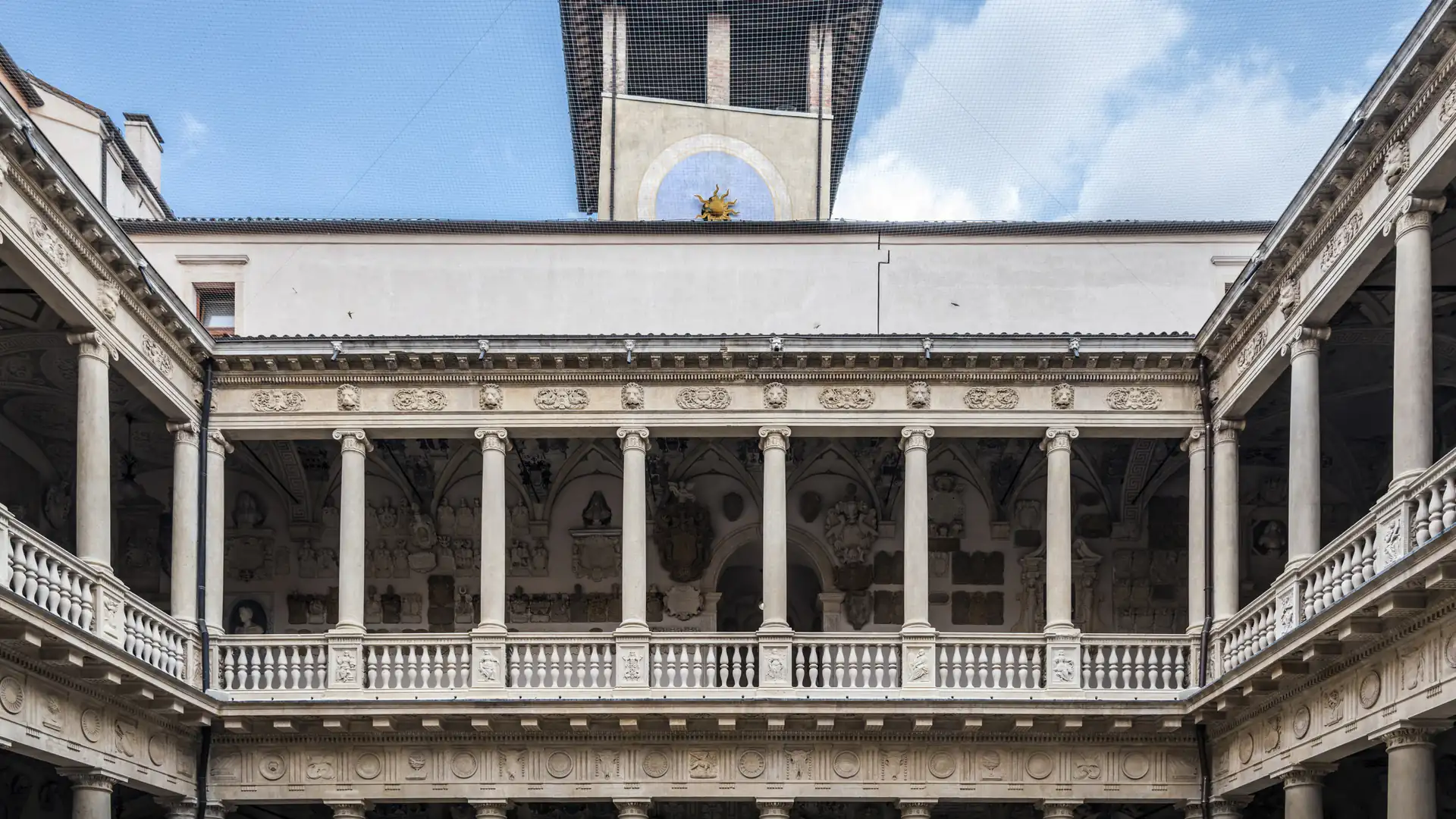
 Skip-the-line available
How to Get to Palazzo Bo from Venice
Trains, trams and timing for a Padua day trip from Venice — station to station in under half an hour, then straight to Palazzo Bo's Anatomical Theatre.
Padua sits on the main line between Venice and Milan, which makes Palazzo Bo one of the simplest heritage day trips out of Venice. Here's exactly how to get from one to the other.
Why Padua works as a Venice day trip
Venice sits at the end of a rail line, and Padua is the first major city on the mainland side of it — close enough that a return trip fits comfortably inside a single day without ever feeling rushed. Where a day trip to somewhere like Verona or Bologna eats up most of a day in transit, Padua takes under half an hour each way by the fastest trains, leaving the bulk of the day for the city itself: Palazzo Bo and its Anatomical Theatre, the Scrovegni Chapel, the Basilica of St Anthony and the rest of the historic centre, all within walking distance of one another. It's also a route with essentially no planning risk — direct trains run every 15 to 20 minutes throughout the day, so there's no single connection to miss and no need to book transport ahead, only your Palazzo Bo tour slot itself.
It's also a trip that works well in either direction of a longer Italian itinerary. Travellers arriving into Venice from Milan, Bologna or further afield on a high-speed Frecciarossa or Italo service often pass directly through Padova on the way, which makes a stopover here — breaking the journey for a few hours before continuing to Venice — just as practical as a dedicated day trip from a Venice base. Either way, the logistics stay simple: Padua doesn't require an overnight stay, a rental car, or any transport booked more than a few minutes ahead, which frees your planning entirely for the one booking that does need to happen in advance — your Palazzo Bo tour slot, and the Scrovegni Chapel's timed entry if you're adding that too.
There's also a genuine historical logic to the pairing, beyond simple convenience: Padua was part of the Venetian Republic for nearly four centuries, and the university itself benefited directly from that relationship — Galileo's own telescope, developed while he held his Padua professorship, was demonstrated to the Venetian Senate from the bell tower of St Mark's Basilica in August 1609, and the senators were impressed enough to double his salary and make his university post a lifelong appointment. Visiting both cities in one trip isn't just efficient train scheduling; it's tracing a single, connected piece of history across two places.
The train from Venice
Trains to Padova (Padua's station) leave from Venezia Santa Lucia, the station at the end of the causeway in central Venice, not from Venezia Mestre on the mainland — though Mestre works too if that's where you're staying. Direct services run every 15 to 20 minutes across the day, operated by a mix of Trenitalia regional and high-speed trains and the private operator Italo; the fastest take as little as 26 minutes, while slower regional trains run closer to 30–40 minutes. Tickets are inexpensive and widely available at station machines, ticket offices or via the operators' own apps; for a trip this short and this frequent, there's little advantage in booking a specific departure far ahead, since the next train is rarely more than a quarter of an hour away. First trains leave Venezia Santa Lucia from around 05:00 and the last around midnight, so timing your outbound journey around your Palazzo Bo departure — not the other way around — is the easier way to plan the day.
For a trip this short, there's rarely a meaningful time advantage in choosing a high-speed Frecciarossa over a regional service, since the difference across a 26-to-40-minute journey is a matter of minutes rather than an hour saved — the deciding factor is usually just which train is about to leave. Regional trains also run frequently outside peak commuter hours, so if you arrive at Santa Lucia and see a regional service boarding two platforms over from the next Frecciarossa, taking it is rarely the wrong call. Keep your ticket until you're through Padova station, since Italian regional and Trenitalia tickets are typically validated before boarding and can be spot-checked on board — a small habit worth having on a route you'll be doing there and back in the same day.
It's also worth knowing that the Venice–Padua line is one of the busiest and most reliable commuter corridors in the Veneto, used daily by students and workers rather than only tourists, which is part of why service is so frequent even outside peak hours. That everyday reliability is genuinely useful for visitors: a missed or delayed train is rarely a serious problem, since another one is never far behind, in a way that isn't true of less-travelled regional lines elsewhere in Italy.
From Padova station to Palazzo Bo
Arriving into Padova, Palazzo Bo is roughly 1.4 kilometres from the station — close enough to walk, far enough that it's worth knowing your options. On foot, the route runs about 20 minutes down Corso del Popolo and into the historic centre, a pleasant walk that gives you a first look at the city before you even reach the palace. Alternatively, the tram line SIR1 runs from a stop right outside the station forecourt into the centre, calling at Eremitani — two stops in, and the closest stop to the Scrovegni Chapel — before reaching Ponti Romani, the stop nearest Palazzo Bo itself and a few minutes' walk from the entrance on Via VIII Febbraio. The tram runs every 8 minutes on weekday daytimes, so it's a fast, low-effort option if you're short on time or simply don't feel like walking with luggage. Either way, build in a small buffer before your booked tour departure, since Padova station can be a short walk from the platform to the exit at busy times.
The walking route itself is a reasonable introduction to Padua in its own right — Corso del Popolo runs fairly directly from the station forecourt toward the historic centre, past the kind of ordinary Italian streets that don't make it into guidebooks but give a real sense of the place, before narrowing into the older, porticoed streets near the university district. If you're arriving with luggage for a longer Veneto trip and Padua is just a stop along the way, the tram is the more comfortable choice; if you're travelling light and have time before your booked departure, the walk costs you nothing but twenty minutes and gives you a better sense of the city than stepping straight off a tram.
Driving and parking
Most visitors coming from Venice take the train, since Venice itself is largely car-free and the rail connection is so direct, but Padua is also an easy drive from elsewhere in the Veneto, sitting just off the A4 motorway between Venice and Milan. Padua's historic centre carries the same kind of limited-traffic zone found in most Italian old towns, with camera-enforced restrictions on unauthorised vehicles, so the practical approach is to park at one of the city's peripheral car parks or park-and-ride sites and continue into the centre on foot or by tram, rather than attempting to drive up to Palazzo Bo itself. If you are combining Padua with a wider Veneto road trip — taking in Vicenza or the Euganean Hills, for instance — arriving by car and parking on the outskirts before walking or tramming in works just as well as the train option for a Venice-based visitor.
One detail worth flagging for anyone driving in specifically for a Palazzo Bo tour rather than a longer stay: because the guided departures run to a fixed schedule and groups are capped, arriving late from an unexpectedly full car park is a real risk in a way it wouldn't be at a site with flexible walk-in entry. If you are driving, build in extra buffer time beyond what a normal city-centre parking search would need, particularly on weekend mornings when Padua's own residents are also out and about and competing for the same peripheral spaces near the historic centre.
Combining Palazzo Bo with the rest of Padua
Because Palazzo Bo sits in the middle of Padua's compact historic centre, a single day trip from Venice comfortably stretches to cover more than the palace alone. The Scrovegni Chapel, with Giotto's early-fourteenth-century frescoes, is two tram stops from the station and a short walk from Palazzo Bo; the Basilica of St Anthony, with its Donatello altar and equestrian statue, lies a further walk south; and the Orto Botanico, the world's oldest university botanical garden, and Prato della Valle, Europe's largest elliptical square, both sit within the same easy walking radius. Because the Scrovegni Chapel also runs on timed, capacity-limited entry, the practical way to plan a one-day Venice-to-Padua trip is to book both Palazzo Bo and the chapel first, around a time gap that lets you walk between them, and build the rest of your wandering — lunch, the basilica, the botanical garden — around those two fixed points.
Beyond the chapel and the basilica, Padua rewards visitors who leave room for at least one unscheduled hour — the porticoed arcades that shelter almost every street in the centre make it a genuinely pleasant city simply to walk through between bookings, in a way that's easy to underrate when you're focused on ticking off two or three major sights. If your day trip from Venice has any slack in it at all, resist the temptation to cram in a fourth or fifth attraction and instead treat the gaps between Palazzo Bo and whatever else you've booked as part of the visit, not dead time to be filled.
Padua's own historical identity is worth a moment's thought while you're walking between sights, too. The city has held the motto “Universa Universis Patavina Libertas” — Paduan freedom for all and everyone — since not long after the university's 1222 founding, and it's a fitting one for a city that drew Copernicus, Galileo and generations of foreign students specifically because it offered more intellectual room to manoeuvre than other European centres of learning at the time. That spirit is easier to sense wandering the porticoes between bookings than reading about it beforehand.
Frequently asked
How long does it take to get from Venice to Padua?
Direct trains from Venezia Santa Lucia to Padova take as little as 26 minutes on the fastest services, or 30–40 minutes on slower regional trains. Services run every 15 to 20 minutes throughout the day.
Which Venice station do I leave from?
Venezia Santa Lucia, at the end of the causeway in central Venice. If you're staying near Venezia Mestre on the mainland, trains run from there too, on the same line.
How do I get from Padova station to Palazzo Bo?
It's about a 20-minute walk down Corso del Popolo, or a short ride on tram line SIR1 to the Ponti Romani stop, a few minutes' walk from the palace entrance on Via VIII Febbraio.
Can I drive from Venice to Padua instead?
You can, via the A4 motorway, though most Venice-based visitors take the train since Venice itself is largely car-free. If driving, park at one of Padua's peripheral car parks and continue into the historic centre on foot or by tram.
Can I see the Scrovegni Chapel the same day as Palazzo Bo?
Yes, easily — they're a short tram ride or walk apart. Since both run on timed entry, book both in advance around a time gap that lets you comfortably walk between them.